




Reforecasting During the Financial Year
See how to turn actual results into an updated year-end outlook, decide when a full reforecast is needed, and assess the implications for profit, cash flow and business plans.
Update the forecast as the year unfolds
The session demonstrates four approaches: a quick projection, a revised profit outlook against the original forecast, a full reforecast using actuals, and a comparison of alternative scenarios.
How do you reforecast during the financial year?
Keep actual results for completed months and revise the assumptions for the remaining period. Start by understanding how sales, gross margin and overheads differ from the original plan. If the changes are material or cash is under pressure, update the cash flow and balance sheet as well as the profit outlook, then compare scenarios where important outcomes remain uncertain.
What you will learn
Choose the right level of detail
Start with a quick projection, update the profit outlook against your original forecast, or prepare a full reforecast when the business needs it.
Understand what has changed
Review sales, gross margin and overhead variances to identify the drivers behind performance, rather than focusing only on the total profit figure.
Check what the business can afford
Review customer collections, supplier payments, VAT and loan assumptions. A stronger profit forecast does not automatically mean more available cash.
Prepare for different outcomes
Compare base, upside and downside scenarios, with clear assumptions, to support decisions about uncertain contracts, expenditure and growth.
From actual results to an updated financial plan
Use the latest reliable data, understand the reasons for change, and choose the level of detail that supports the client’s next decision.
Update the reporting date
Set the client’s reporting date to the latest reliable accounting month so the reports and models use the relevant actual results.
Compare actual results with the original forecast
Copy the Performance versus Forecast Data from the Business Data Model into your existing forecast, then select the corresponding reporting month.
Revise the year-end profit outlook
Review the remaining months’ sales, margin and overhead assumptions. Use known future activity, recent trends and business plans to inform the changes.
Assess whether a full reforecast is needed
Consider the size and cause of the variances, the business’s cash position and the working capital implications before deciding how much detail is required.
Combine completed months’ actuals with future assumptions
Generate a customer or nominal forecast model using the latest reporting date, then set its start date to the beginning of the financial year. Check the remaining months’ profit and loss, balance sheet, debt and cash flow assumptions.
Compare scenarios and agree the next action
Save alternative scenarios, document the assumptions and compare the outputs. Use the results to discuss which plan to adopt and what the business needs to do next.
Find the section you need
Use these transcript-based timings to find each topic. Select a time to open that point in the recording on Vimeo.
Introduction and the clients this applies to
Where reforecasting fits within regular reporting, financial planning and advisory support.
A quick projection using the Board Report
Estimate the year-end profit outlook from current performance and historical comparisons.
Bring actuals into an existing forecast
Use the Business Data Model to compare monthly and year-to-date results against the original plan.
Revise sales, gross margin and overheads
Update the remaining months using overall adjustments or specific monthly figures.
Use the supporting analysis
Review the detailed performance information and sense-check the longer-term profit assumptions.
When to prepare a full reforecast
Consider material variances, cash constraints and the working capital impact of changed trading.
Set up the model with actuals for completed months
Use the latest reporting date and align the forecast start date with the financial year.
Update revenue, margin and overhead assumptions
Reflect seasonality, known contracts and changes in the remaining months of the year.
Review the balance sheet and cash assumptions
Check classifications, loans, VAT, receivables, payables and other working capital movements.
Build and compare alternative scenarios
Save base, upside and downside versions and compare the results and underlying assumptions.
Recap: selecting the right approach
Bring together the four ways to update the expected financial outcome.
A quick projection or a full reforecast?
The right approach depends on what has changed and the decision you need to make. Each method provides a different level of detail.
| Approach | Starting point | What it provides | What to check |
|---|---|---|---|
| Board Report / Board Summary | Current performance and historical comparisons | A quick, high-level year-end profit outlook | A projection does not incorporate a detailed review of future trading changes or working capital. |
| Performance versus Forecast | Actual results compared with your original forecast | A revised profit outlook based on updated sales, margin and overhead assumptions | Updating profit expectations does not establish the cash flow or working capital impact. |
| Full reforecast | Completed months’ actuals plus revised future assumptions | An updated profit and loss, cash flow and balance sheet forecast | Check accounting data, classifications and business-specific assumptions before using the outputs. |
| Scenario comparison | Alternative versions of the revised forecast | A comparison of possible outcomes and the assumptions behind them | Each scenario needs coherent sales, cost, cash and working capital assumptions. |
Higher profit does not automatically mean more cash
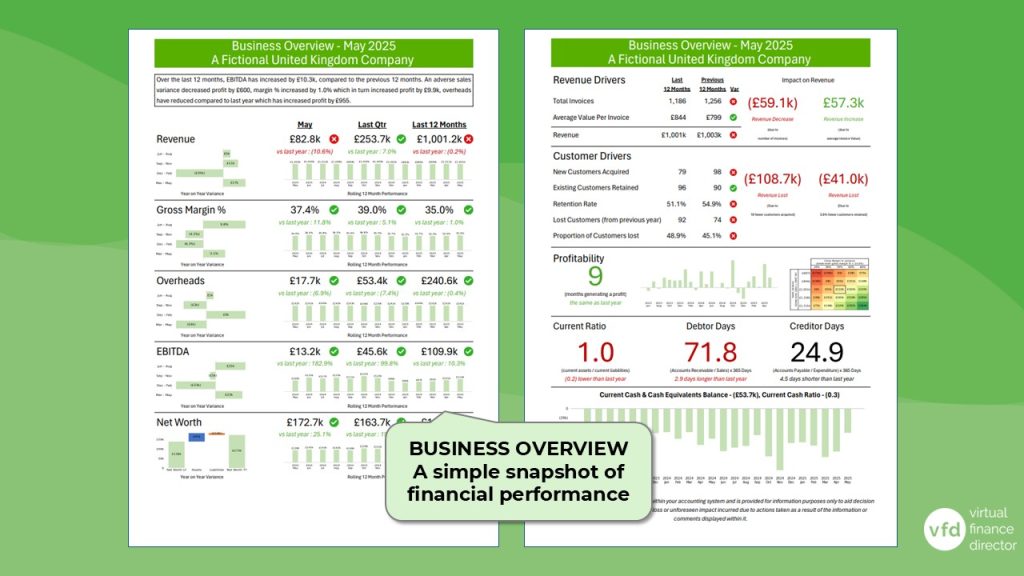
The demonstration shows a business whose improved profit outlook is largely driven by lower overheads, despite a weaker margin. A different business could be growing sales while waiting longer for customers to pay. Understanding the cause of the change helps you assess the cash impact and what the business can afford to do next.
For advisors supporting regular financial decisions
This session is particularly relevant to clients receiving monthly or quarterly reporting, forecasting and financial planning support.
- Accountants and client managers reviewing actual results against an agreed financial plan.
- Business advisors helping owners understand changing performance and growth options.
- Fractional FDs and CFOs assessing cash requirements, expenditure and uncertain trading outcomes.
- Outsourced finance teams preparing updated forecasts and management discussions.
- VFD Pro users looking for a practical demonstration of the reporting, forecasting and scenario tools.
Reforecasting questions answered
What is reforecasting during the financial year?
Reforecasting updates the expected financial outcome using actual results for completed months and revised assumptions for the remaining period. It helps a business understand where it is now likely to finish the year and what that means for profit, cash and future plans.
Can I estimate the year-end result without preparing a full forecast?
Yes. The VFD Board Report and Board Summary can project current performance forward using historical comparisons. This provides a high-level profit outlook, but does not incorporate a detailed review of future contracts, business changes or working capital requirements.
How do I compare actual results with my original forecast?
Generate the Business Data Model at the latest reliable reporting date. Copy its Performance versus Forecast Data into the corresponding tab in your existing forecast model, then select that reporting month in the Performance versus Forecast tab.
When should I move from a profit update to a full reforecast?
When changes are material, cash is tight, or revised trading assumptions could affect working capital and funding decisions. The session discusses variances of around 5–10% as an illustrative prompt for review, but the decision depends on the business and the cause of the variance; it is not a fixed rule.
Do I need to re-enter actuals for every completed month?
The session demonstrates generating a customer or nominal forecast model using the latest reporting date, then moving the forecast start date back to the beginning of the financial year. Available actuals populate the completed months, leaving you to focus on future assumptions.
Why can profit improve while cash remains under pressure?
Extra sales may require the business to pay suppliers and operating costs before collecting customer payments. VAT, loan repayments and other balance sheet movements also affect available cash. A full reforecast helps you assess those timings alongside the profit outlook.
Can I compare different reforecast scenarios?
Yes. The demonstration saves base, upside and downside versions of the forecast with their assumptions. The model can store multiple scenarios and display up to five side by side, helping you compare the financial consequences of different outcomes.
Put reforecasting into practice with your clients
Choose one client with an existing forecast, bring in the latest actuals and identify the main variances. Update the remaining months and, where the changes are material or cash is tight, prepare a full reforecast and compare the scenarios that matter.