




Understanding the Utilities Opportunity card
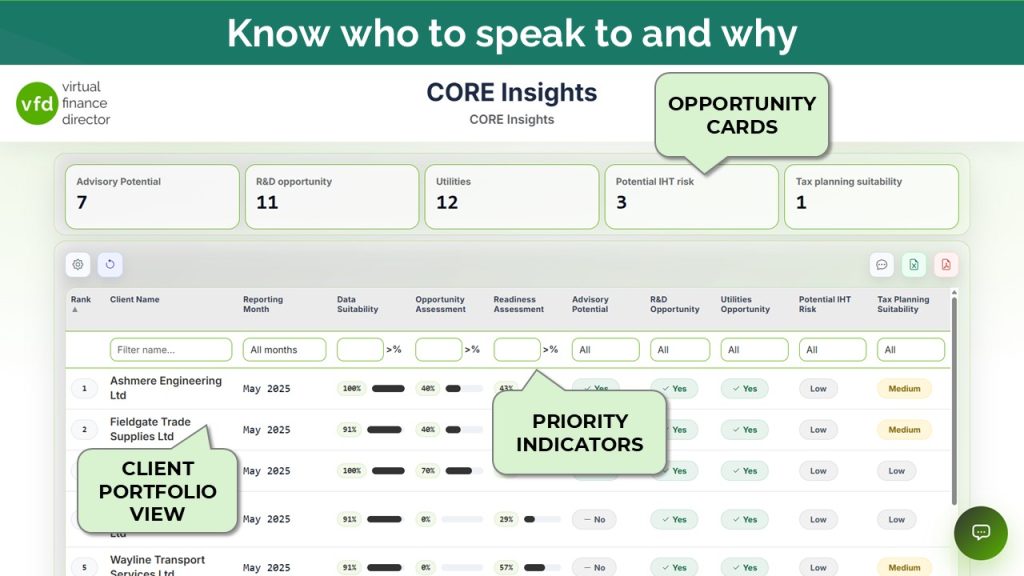
Understand how utility expenditure, changes in spend and service categories help you identify clients for a commercial review.
Your guide to utilities
Select a section to open its guidance. On mobile, the panel opens beneath the selected button.
Understanding the card
Identify clients for a utilities review
Outcome: You understand which services and expenditure the card can bring to attention.
A utilities review can cover more than electricity and gas. Depending on how expenditure is recorded and mapped, CORE Insights can also identify water, telecoms, broadband, waste management, fuel and facilities-related costs.
The purpose is to prioritise clients for investigation. A review may lead to a supplier comparison, contract check or examination of consumption and usage.
High expenditure is a reason to review. It does not establish that the client is overpaying or that a particular saving is available.
Behind the assessment
Review spend, changes and service categories
Outcome: You understand the three indicators used in the assessment.
| Indicator | What it reviews | How to use it |
|---|---|---|
| Spend materiality | Mapped utility expenditure within Cost of Sales and Overheads over the previous 12 months. | Identify clients whose spend is substantial enough to investigate. |
| Spend change | Spend in the last 12 months compared with the preceding 12 months. | Understand the change and investigate its causes. |
| Expenditure sources | Distinct mapped utility categories identified over the previous 24 months. | Assess the scope for a review across several services. |
The guide describes a default materiality threshold of £10,000. Under that methodology, spend must be above £10,000 to trigger the overall opportunity; expenditure equal to the threshold does not trigger it.
The spend-change indicator displays a positive increase. The expenditure-sources indicator displays the count where more than one category is identified.
Reading the result
Understand the materiality trigger
Outcome: You can distinguish the overall trigger from supporting information.
The Spend Materiality indicator determines the overall Utilities Opportunity result. Spend change and expenditure sources provide additional information for deciding what to investigate.
An increase could reflect tariffs, higher consumption, additional premises, business growth or the timing of invoices. Check the underlying bills and business context before interpreting it as a procurement problem.
A “No” result does not establish that existing contracts offer good value. It means the recorded spend has not triggered this screening assessment.
Illustrative figures
From utility spend to a review prompt
Outcome: You can interpret a spend increase without treating it as an achievable saving.
| Measure | Illustrative result |
|---|---|
| Previous 12-month spend | £20,000 |
| Latest 12-month spend | £35,000 |
| Increase in recorded spend | £15,000 |
| Utility categories identified | 2 |
With a £10,000 materiality threshold, the £35,000 spend would trigger an opportunity for review. The £15,000 increase provides a useful discussion point; it is not an estimate of recoverable savings.
The accountant should first establish whether the business has expanded, consumed more or experienced changes in contract rates.
Taking action
Check contracts, consumption and costs
Outcome: You have a practical checklist for investigating the finding.
- Check which accounts and services make up the recorded expenditure.
- Compare bills, consumption and unit rates across the relevant periods.
- Review contract terms, renewal dates, termination provisions and supplier arrangements.
- Identify the services where a commercial review could be useful.
- Agree responsibility for the review and record the next action.
Questions to start the conversation
- Has usage changed, or have your rates increased?
- When do the main contracts renew?
- Who reviews supplier terms and monitors consumption?
Further clarification
Common questions about utilities opportunities
Does a utilities opportunity mean the client is overpaying?
No. It means recorded expenditure is above the screening threshold. Supplier terms, usage and business circumstances need to be reviewed.
Which services can be included?
The guide includes electricity, gas, water and sewerage, broadband, internet, telecoms, facilities charges, waste management, fuel and service charges. Coverage depends on the records and nominal mapping.
Is an increase in spend required to trigger the opportunity?
No. Under the guide’s methodology, spend materiality determines the overall result. An increase adds context.
Does the card calculate achievable savings?
No. Recorded spend and changes in spend help identify a review opportunity. Any saving needs to be established through a separate assessment.
What if utility costs are recorded in a general expense account?
Review the mapping and underlying records. Incomplete or inconsistent classification can affect the assessment and may require further investigation.
Continue your CORE Insights review
Review a client's card, check the supporting detail and agree a useful next action.
Return to the CORE Insights quick-start guide →