




Understanding the Tax Planning Suitability card
Understand how the Tax Planning Suitability assessment helps you prioritise client reviews, then investigate the financial signals and planning circumstances.
Your guide to tax planning
Select a section to open its guidance. On mobile, the panel opens beneath the selected button.
Understanding the card
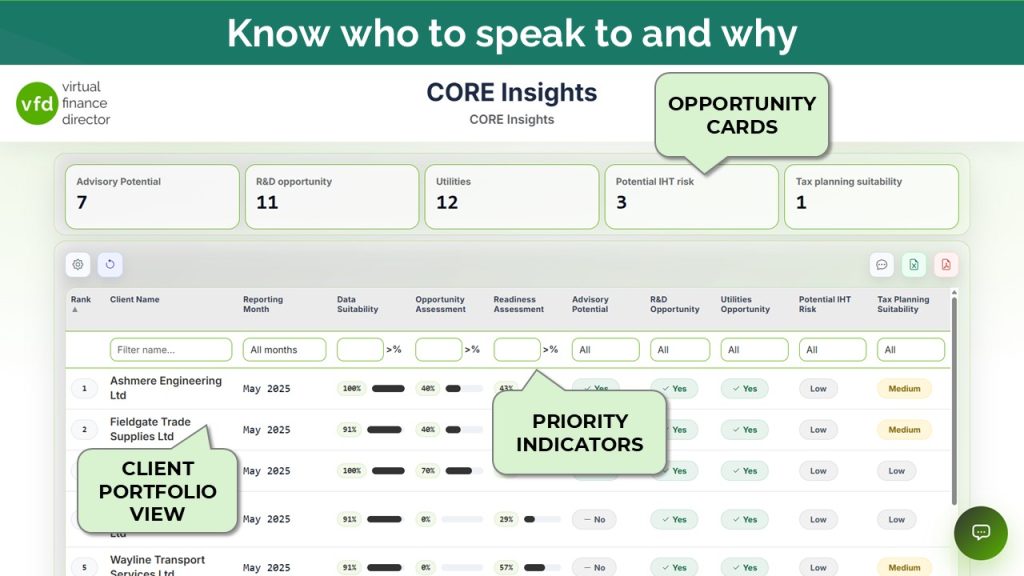
Prioritise clients for planning conversations
Outcome: You understand how the assessment supports client prioritisation.
A practice may have many clients who could benefit from a review, but limited time to investigate every business in equal depth. This assessment provides a consistent starting point for deciding which clients to look at first.
Use the result alongside your knowledge of the client and any planning already undertaken. A signal can support a question; it does not establish which strategy is suitable.
The score is a prioritisation aid. It is not a calculation of tax payable, a promised saving or a recommendation to undertake a particular transaction.
Behind the assessment
Review the financial signals
Outcome: You understand the financial indicators described in the guide.
Earnings and earnings growth
Higher or increasing earnings can prompt a review of the client’s tax position and future planning requirements.
Dividends relative to earnings
The relationship between dividends and recorded earnings can prompt a closer look at how owners take value from the business.
Cash balances
Cash held by the business can prompt discussion about its purpose, future commitments and the owners’ objectives.
Fixed asset movements
Changes in fixed asset values can highlight investment worth investigating. Review additions and supporting records before considering tax treatment.
Revenue growth
A growing business may need to revisit its planning as its scale and commercial circumstances change.
Debtor days
Slow customer collections can prompt a working-capital discussion and a review of relevant arrangements.
These signals support the review process described in the guide. Potential discussion topics include profit extraction, pensions, capital allowances, business structure and relevant VAT arrangements. The appropriate scope depends on the client’s circumstances and your further assessment.
Reading the result
Use the assessment alongside your judgement
Outcome: You can interpret a suitability result in the client's wider context.
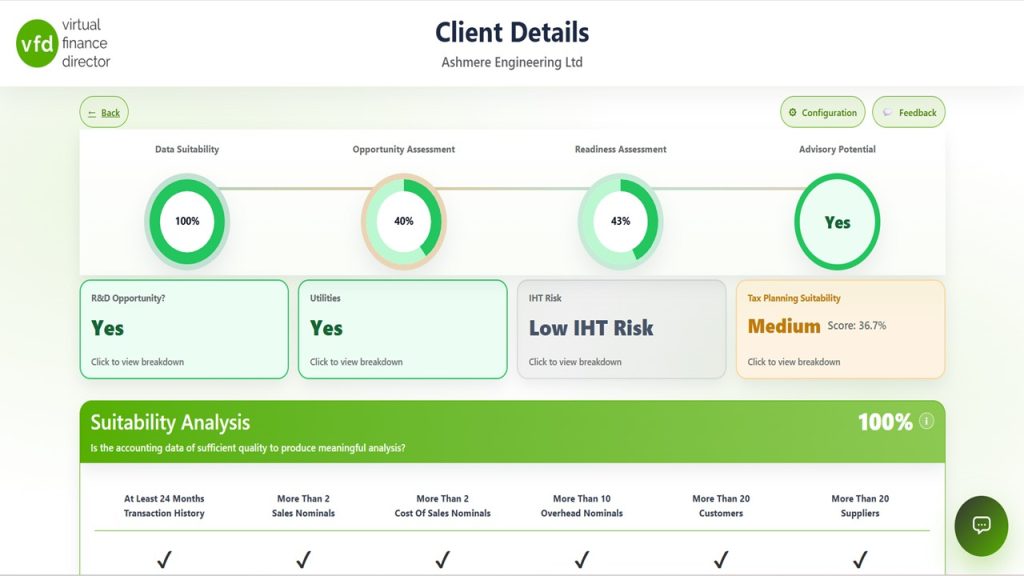
Open the Tax Planning Suitability card in the client view and review the individual measures behind the result. Establish what has changed and whether the practice has already addressed the issue.
A higher suitability result gives a reason to investigate sooner under the assessment’s rules. A lower result does not establish that tax planning would provide no benefit.
The same signal can have different explanations. A large cash balance may be reserved for an acquisition; asset growth may reflect a change in accounting records; higher debtor days may reflect a seasonal trading pattern.
Illustrative situation
From changing finances to a planning review
Outcome: You can see how a finding leads to a planning conversation.
Illustrative example: a client’s earnings and revenue have increased, dividends have risen, and the company holds substantial cash. The client has not had a recent planning review.
The accountant checks those movements and asks about the cash requirements, owners’ objectives and plans for the next year. This can establish whether a remuneration or wider tax-planning review is appropriate.
The assessment helps prioritise the conversation. It does not specify an optimal salary, dividend or pension contribution, and it does not quantify a tax saving.
Taking action
Check the circumstances and agree a review
Outcome: You have a clear starting point for an appropriate client review.
- Review the financial measures behind the card and confirm that the records are current.
- Check what planning has already been undertaken and which periods it covers.
- Ask about future investment, cash commitments and the owners’ objectives.
- Agree the scope of any further review, including specialist involvement where needed.
- Record the next action and review the position when circumstances change.
Questions to start the conversation
- Have your personal income requirements or business plans changed?
- What is the cash in the business intended to fund?
- When did we last review how the owners take value from the company?
Further clarification
Common questions about tax planning suitability
Does a high suitability result guarantee a tax saving?
No. It highlights financial signals that may justify a review. Any planning benefit depends on the client’s circumstances and applicable rules.
Does the assessment recommend a remuneration strategy?
No. It can prompt a remuneration review, but a suitable strategy requires consideration of the owners, company and wider circumstances.
Does a low result mean the client needs compliance support only?
No. It indicates a lower priority under this assessment. Your knowledge of the client may reveal other reasons to undertake planning.
Are debtor days a direct measure of tax savings?
No. Debtor days describe collection performance and can support a working-capital discussion. They do not directly quantify a tax saving.
What if we already provide tax planning to every client?
Use the assessment as an additional review prompt. Check whether a finding has already been addressed and whether changing circumstances justify further work.
Continue your CORE Insights review
Review a client's card, check the supporting detail and agree a useful next action.
Return to the CORE Insights quick-start guide →