




Understanding the R&D Opportunity card
Understand how the R&D Opportunity card identifies financial signals worth investigating, then check the projects and expenditure behind the result.
Your guide to R&D
Select a section to open its guidance. On mobile, the panel opens beneath the selected button.
Understanding the card
Identify clients for an R&D review
Outcome: You understand what the card identifies and why further investigation is needed.
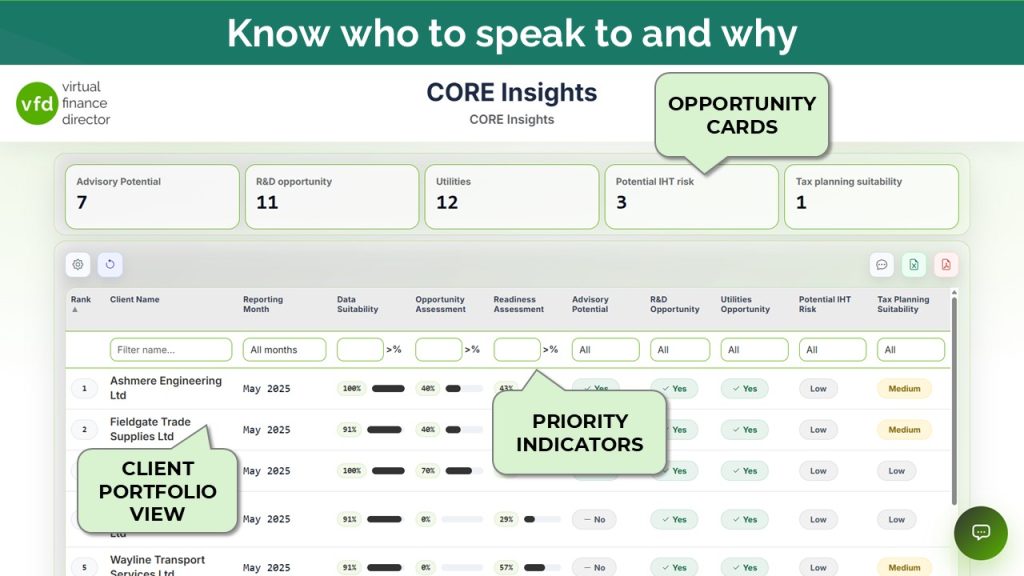
R&D activity may be recorded in everyday expense accounts, fixed assets or transaction descriptions rather than in an account labelled “research and development”. CORE Insights reviews these signals across connected clients to help you decide where a conversation may be worthwhile.
A screening result requires investigation. A positive card does not establish eligibility for tax relief, the amount of qualifying expenditure or the value of a claim.
Behind the assessment
Review the four opportunity indicators
Outcome: You understand the financial and industry signals behind the assessment.
Fixed asset expenditure
Reviews expenditure mapped to the R&D identifier list for investment that may be connected with development, testing, design or technical activity.
Operational expenditure
Reviews relevant expenditure within Cost of Sales and Overheads. Development work can appear in operational accounts rather than as a capital investment.
Industry classification
Compares the client’s SIC code with the model’s R&D industry list. This provides context about the type of business.
Transaction descriptions
Looks for terms associated with research, engineering, software, prototypes and technical development. A description match needs to be checked in context.
The expenditure indicators use a materiality threshold to help focus the review. Check the R&D configuration applied to the client when interpreting a result.
These identifiers detect potentially relevant records. The accounting label, supplier description or industry classification does not establish that an activity or cost qualifies for relief.
Reading the result
Check the evidence behind the result
Outcome: You can interpret the result without treating it as eligibility for relief.
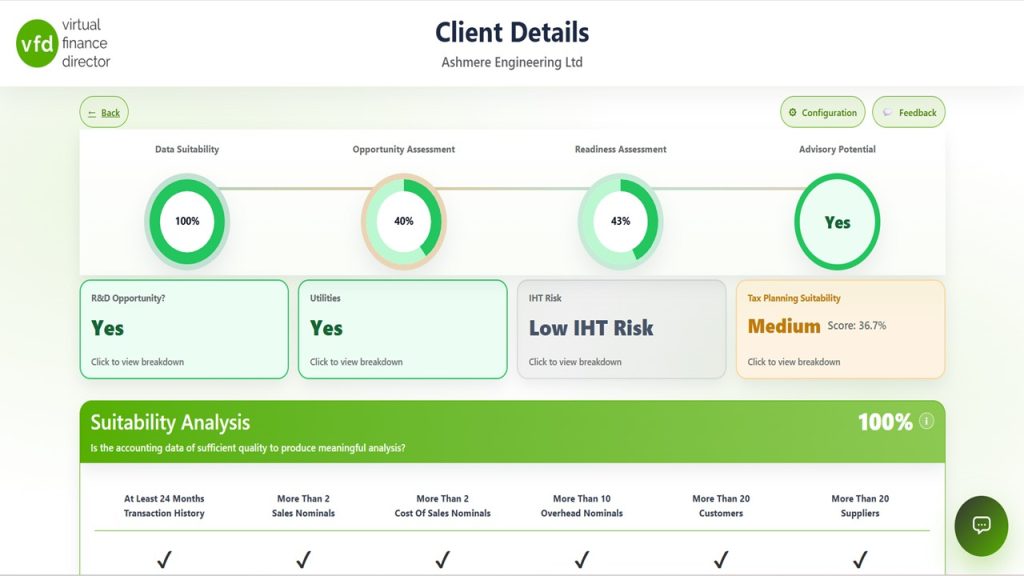
Open the R&D Opportunity card within the client view to see the indicators behind the result. Check which indicator has been triggered and trace the relevant expenditure back to the underlying records.
The source methodology includes a safeguard: a transaction-description match on its own does not produce a positive overall opportunity result. This helps limit isolated keyword matches without supporting evidence.
A “No” result means the assessment has not flagged an opportunity under the applied rules. It does not establish that the client has no qualifying R&D activity.
Illustrative figures
From an expenditure signal to a review
Outcome: You can distinguish expenditure identified for investigation from qualifying costs.
Illustrative example: an engineering client has £35,000 of operational expenditure linked to development-related account descriptions. Its customer projects include prototype work.
The card can prompt the accountant to ask what the projects involved, examine the matched transactions and determine whether a specialist review is appropriate. The £35,000 is an amount identified for investigation; it is not automatically qualifying expenditure or a tax saving.
Taking action
Investigate the activity and agree the next step
Outcome: You have a clear starting point for a relevant client discussion.
- Open the client’s card and identify the evidence behind the result.
- Review the transaction descriptions, nominal mapping and supporting invoices.
- Ask the client about the development projects and any scientific or technological uncertainties they sought to resolve.
- Check whether the client has already claimed or obtained specialist advice for the relevant period.
- Agree whether further assessment is needed and record the next action.
Questions to start the conversation
- What were you trying to develop or improve?
- What technical problems could not readily be resolved at the outset?
- Who worked on the project, and what records are available?
Further clarification
Common questions about R&D opportunities
Does a positive result mean the client can claim R&D relief?
No. It indicates that further investigation may be worthwhile. Eligibility depends on the activities, evidence, costs and rules applicable to the accounting period.
Is the expenditure threshold an HMRC eligibility rule?
No. It is a CORE Insights screening setting used to prioritise reviews. It does not create a statutory minimum claim amount.
Why might transaction descriptions produce misleading matches?
A term such as “development” or “design” can describe routine work. Review the actual project and supporting evidence before drawing a conclusion.
Can genuine R&D activity be missed?
Yes. Activity may not be recognisable in the available records or may not meet the screening criteria. Use your knowledge of the client alongside the assessment.
Does the industry indicator establish eligibility?
No. It provides a screening signal. A client’s SIC code does not determine whether a particular project meets the requirements for relief.
For current scheme and eligibility guidance, see HMRC’s R&D tax relief guidance. Check the rules for the relevant accounting period before advising on a claim.
Continue your CORE Insights review
Review a client's card, check the supporting detail and agree a useful next action.
Return to the CORE Insights quick-start guide →