




Understanding the IHT Risk card
Understand how indicative business value helps you identify clients for inheritance tax and succession planning discussions, then decide what to check next.
Your guide to the IHT assessment
Select a section to open its guidance. On mobile, the panel opens beneath the selected button.
Understanding the card
Identify clients for a planning discussion
Outcome: you understand why a client has been highlighted and what the card can tell you.
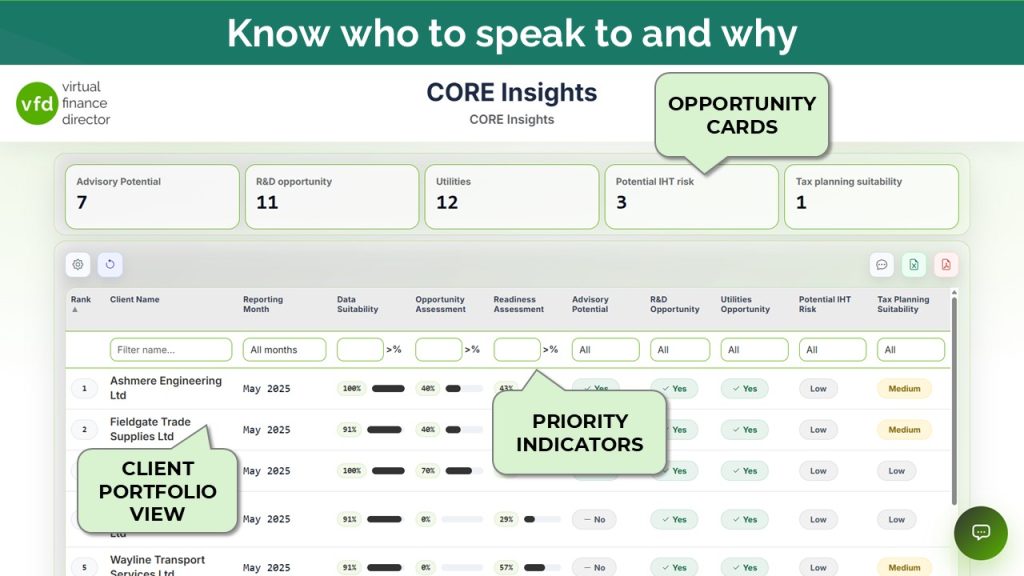
The IHT Risk card compares an indicative business value with a review threshold configured by your firm. It helps you identify clients who may benefit from a conversation about ownership, succession and inheritance tax planning.
As a business grows, its value can become an increasingly important part of the owner's wider planning. The card brings these businesses to attention so you can investigate their circumstances.
The configured threshold is a screening benchmark. It is not a statutory tax allowance. The card does not calculate an individual owner's inheritance tax liability or establish entitlement to relief.
Behind the assessment
Review the earnings, multiple and threshold
Outcome: you understand the key inputs behind the business-value assessment.
| Measure | What it tells you |
|---|---|
| Current-year EBITDA | The current earnings measure used in the assessment. |
| Prior-year EBITDA | The comparison earnings measure. |
| EBITDA change | Whether earnings have increased or decreased. |
| Configured multiple | The multiple used to support the indicative valuation. |
| Configured threshold | Your firm's benchmark for prioritising a planning review. |
| Potential value | The model's estimated business value. |
| Category | The result assigned under the assessment rules. |
Review the earnings figure, multiple and threshold together. Check that the configuration is appropriate for the business you are reviewing.
The assessment also considers earnings trends as a business approaches the configured threshold. The estimated value is a screening figure and should not be treated as a formal valuation.
Reading the result
Use the category to prioritise further review
Outcome: you can interpret the screening result alongside your knowledge of the client.
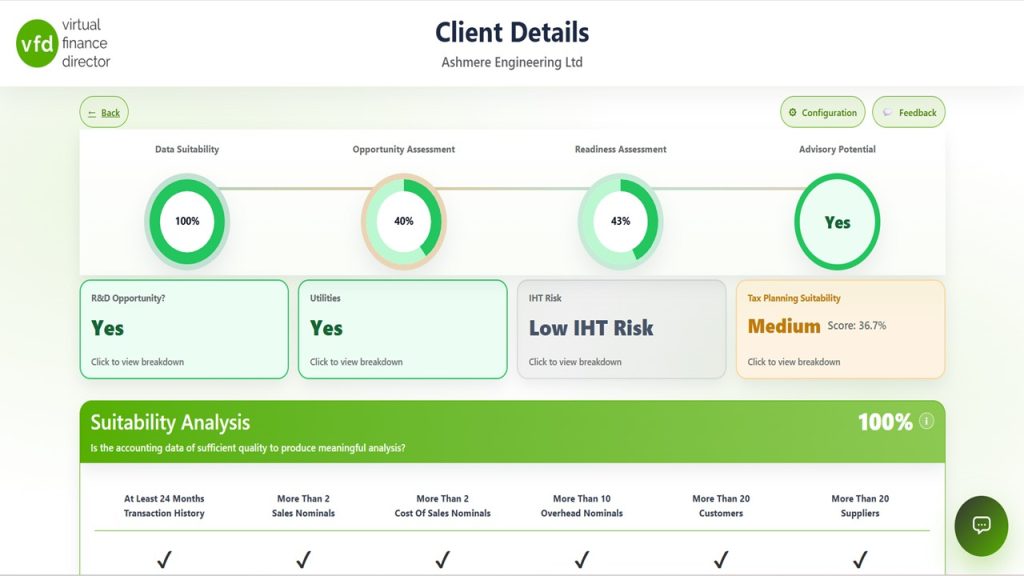
The business is above, or sufficiently close to, the configured benchmark to prioritise review under the assessment rules.
The business is approaching the configured benchmark and may warrant a planning conversation or monitoring.
The assessment assigns a lower priority under its configured rules. Other circumstances may still make a review important.
These are product screening categories. They do not establish the owner's personal tax exposure. Shareholdings, other assets, existing arrangements and applicable reliefs require separate consideration.
Illustrative figures
From indicative value to a review prompt
Outcome: you can see how an illustrative business value compares with a configured threshold.
| Example input | Illustrative figure |
|---|---|
| EBITDA | £300,000 |
| Configured multiple | 4 |
| Indicative business value | £1,200,000 |
| Configured review threshold | £1,000,000 |
In this illustration, £300,000 × 4 gives an indicative value of £1.2 million. Because it exceeds the configured £1 million review threshold, the guide would classify the business as IHT Risk.
The next step is to check ownership and planning circumstances. The £1 million figure is an example screening setting, not a statutory allowance. The example does not establish an amount of tax payable.
Taking action
Check the detail and agree the next action
Outcome: you have a clear starting point for a relevant client discussion.
- Check the earnings figure, configured multiple and resulting indicative value.
- Confirm who owns the business and the size of each shareholding.
- Ask about the owners' succession, sale and family objectives.
- Review existing planning arrangements and establish whether specialist advice is needed.
- Record the agreed next action and revisit the position as circumstances change.
Questions to start the conversation
- What would you like to happen to the business in the future?
- When were your ownership and estate-planning arrangements last reviewed?
- Have changes in the business or your family circumstances affected those plans?
Further clarification
Common questions about the IHT Risk card
Is the threshold an inheritance tax allowance?
No. It is a benchmark configured within CORE Insights to help prioritise client reviews. It is not a statutory allowance or relief limit.
Does “IHT Risk” mean the owner will owe tax?
No. It indicates that a planning review may be appropriate under the assessment. The owner's circumstances, ownership and applicable rules need separate review.
Is the estimated value a formal valuation?
No. It is an indicative figure used for screening. A formal valuation may require a broader assessment of the business.
What if there are several shareholders?
Review each owner's shareholding and circumstances. A whole-business value does not establish the value attributable to any one owner.
Does “Low IHT Risk” mean no planning is needed?
No. The category reflects this assessment. Other assets, family objectives or succession issues may still warrant advice.
For current tax context, see GOV.UK inheritance tax guidance and Business Relief guidance.
Continue your CORE Insights review
Use the IHT card to identify a client, check the supporting detail and agree a useful next step.
Return to the CORE Insights quick-start guide →