




How to Prioritise Advisory Opportunities Across Your Client Portfolio
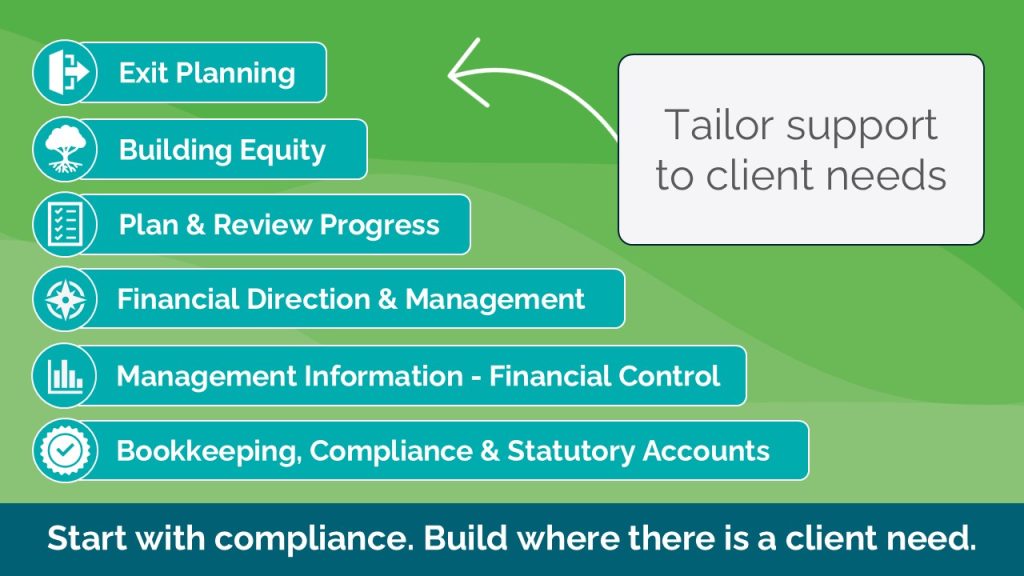
A client portfolio may contain dozens or hundreds of potential risks and opportunities. The challenge is not finding more data; it is deciding which clients need attention, why the conversation matters and where limited advisory capacity can have the greatest impact.
How can accounting firms prioritise client advisory opportunities?
Start by defining what deserves attention before reviewing individual clients. Apply consistent criteria across the portfolio, separate data suitability from commercial opportunity and client readiness, set materiality thresholds that would genuinely prompt action, and then filter the results to match the team’s available capacity. The result should be a manageable list of evidence-led conversations, not a longer report.
More information does not automatically create better client service
Most accounting firms already hold a substantial amount of client financial data. What they often lack is a consistent way to determine where that information should lead to action.
Reviewing clients individually can make proactive service difficult to scale. Attention may be driven by whoever contacts the firm most often, whichever year end is approaching or which client a team member happens to know best. Important changes elsewhere in the portfolio may remain unnoticed until they become urgent.
A portfolio-level process changes the starting point. Instead of asking, “What can we report for this client?”, the practice asks:
- Which clients show a meaningful risk or opportunity?
- Is the underlying data suitable for reliable analysis?
- Which business owners may be ready for a broader conversation?
- What is the likely financial significance of the change?
- How many conversations can the team realistically progress?
Five decisions that create a useful priority list
The strongest prioritisation process begins with the practice’s objectives and operational reality. These five decisions provide a practical starting framework.
Define the decision you want to support
Be clear about the purpose. You may be identifying clients for advisory discussions, finding working-capital concerns, planning a targeted service or improving periodic client reviews.
Decide which clients should be assessed together
Not every measure is relevant to every business. Stock metrics may be important for a wholesaler but meaningless for a consultancy. Group clients where their commercial characteristics require different treatment.
Select criteria that would change what you do
A measure should earn its place in the assessment. Ask whether the result would cause the team to contact a client, change the agenda or recommend a next step.
Set meaningful materiality thresholds
A small movement may be important for one KPI and irrelevant for another. Set the point at which the change becomes commercially significant rather than flagging every variance.
Match the output to available capacity
A list of 50 clients is not useful when the team can progress only 10 conversations. Decide what can be acted upon and refine the list accordingly.
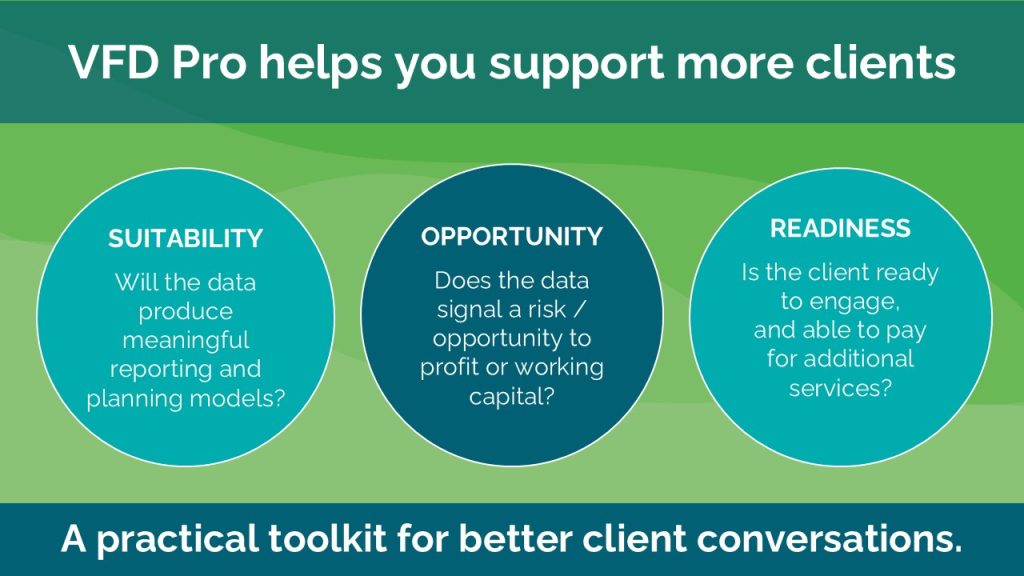
Separate suitability, opportunity and readiness
A client can show a large financial movement without being ready for an advisory discussion. Equally, a receptive client may not have sufficiently current or well-structured data to support reliable conclusions. Treating these questions separately produces a more balanced priority assessment.
| Assessment | Question it answers | Examples of evidence | How it informs action |
|---|---|---|---|
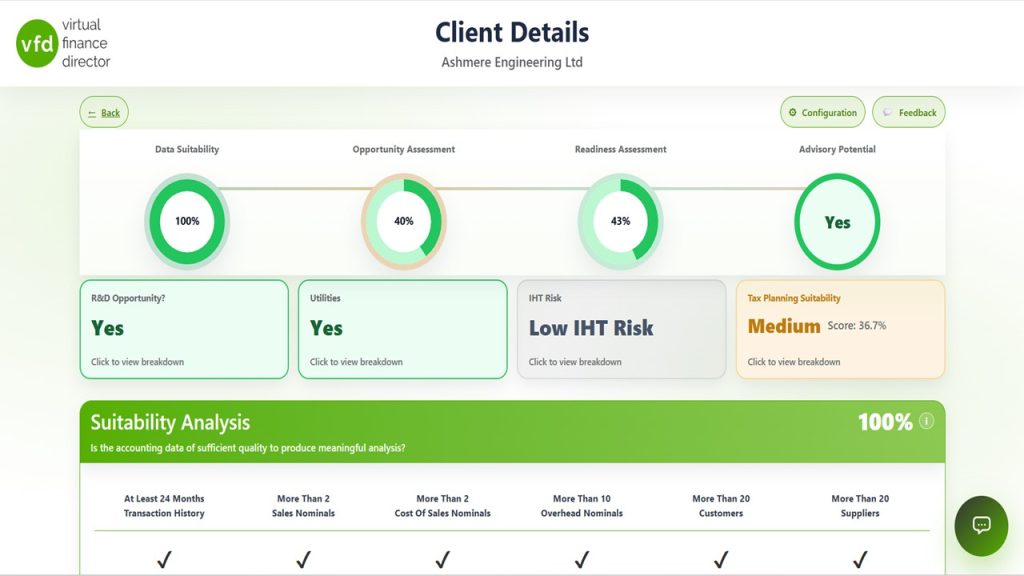
| Suitability | Is the accounting data appropriate for meaningful analysis? | Reporting history, account structure, customer and supplier coding, visible cash balances and regular transaction processing. | Shows whether the insight is sufficiently reliable or whether improving the data should come first. |
| Opportunity | Is there a material risk or improvement opportunity? | Revenue, gross margin, overheads, EBITDA, customer activity, cash, debtor days, creditor days and stock. | Identifies the areas with the strongest potential financial impact and the reason for a conversation. |
| Readiness | How receptive might the client be to acting on the insight? | Profitability, positive cash, improving results, dividends and other signs of commercial capacity. | Helps the advisor plan the timing, tone and scope of the approach while still applying personal knowledge of the client. |
Create the assessment first, then refine the working list
Define what qualifies
Configuration determines how clients are assessed. It contains the relevant criteria, directions of movement, thresholds and client groups.
Decide what to address now
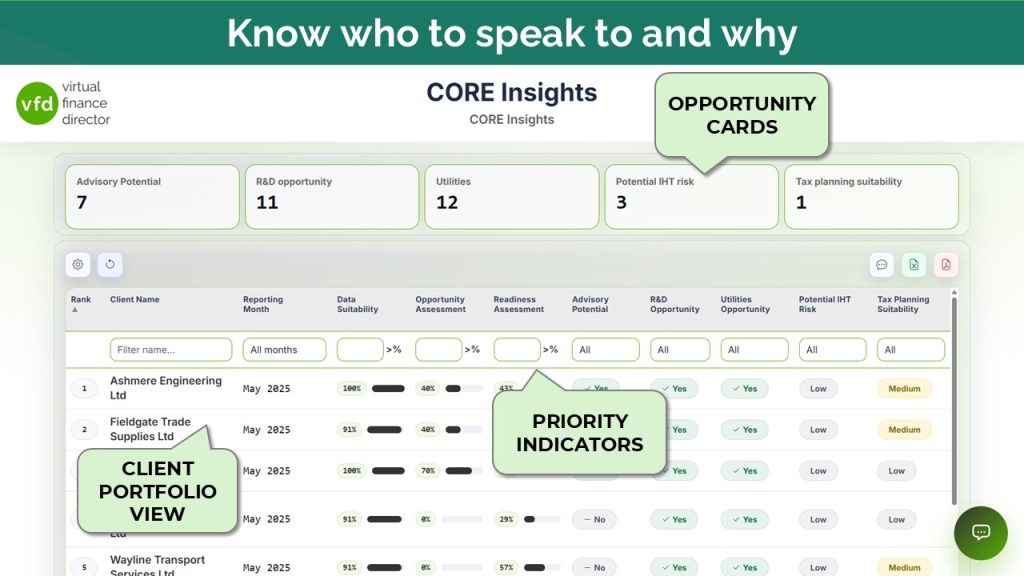
Filtering works with the configured results. It narrows the list for a particular campaign, service, review period or level of capacity.
Add what the data cannot know
The numbers provide evidence, but the advisor still considers the relationship, personal circumstances, strategic plans and the best way to engage.
From a portfolio signal to an actionable shortlist
Suppose a practice assesses 200 clients. Its chosen criteria identify 50 businesses with potential advisory value, but the team has capacity for 10 focused conversations during the next quarter.
The answer is not necessarily to keep changing the configuration until only 10 clients remain. The configuration should continue to represent what the practice considers important. Filters can then identify the strongest current opportunities—for example, clients with the highest opportunity assessment, a particular working-capital issue or a relevant service need.
This preserves a consistent portfolio view while creating a practical quarterly working list.
A repeatable six-step advisory workflow
Prioritise
Identify the clients whose combination of data suitability, opportunity and readiness merits closer review.
Understand
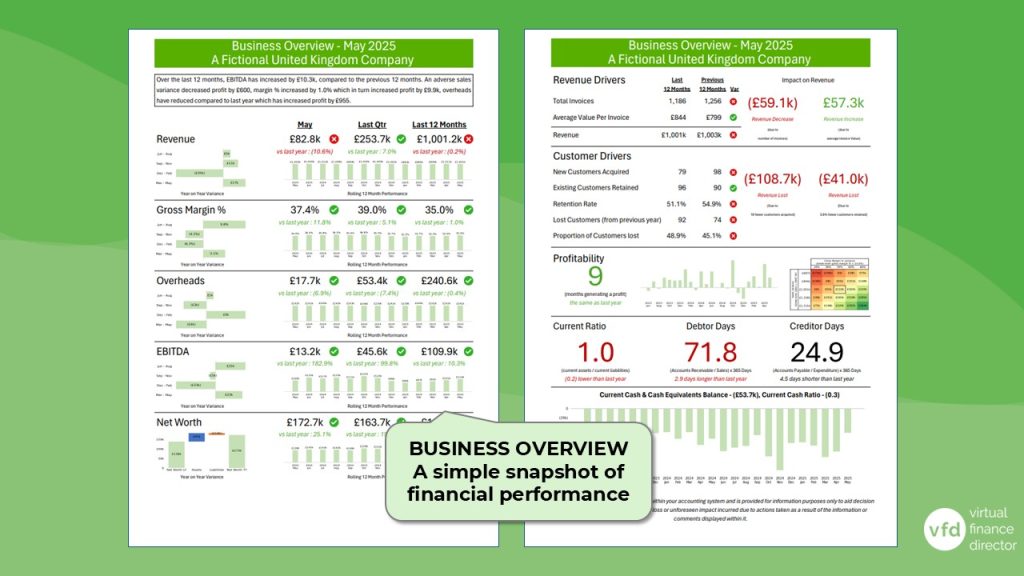
Review the financial performance, working-capital position and underlying business drivers behind the portfolio signal.
Quantify
Express changes in revenue, margin, overheads, customer activity or working capital in financial terms.
Prepare
Select the issues that matter most and create a focused agenda with relevant questions and supporting reports.
Discuss
Use the evidence to begin a commercially relevant conversation rather than presenting a general report.
Follow through
Record agreed actions against the relevant KPIs so they can be reviewed during the next client discussion.
Three ways to use prioritised client insight
Prepare a more focused meeting
Start with the evidence that triggered attention, examine the financial effect, select the most important drivers and build the meeting around decisions and actions.
Find the right audience
Use portfolio data to identify businesses that may benefit from lending support, working-capital education, tax planning, succession discussions or another relevant service.
Remain relevant throughout the year
Combine education, accessible performance information, self-service analysis and periodic advisor-led reviews into a consistent client experience.
Use the Four I’s to create an ongoing client journey
Prioritisation is most valuable when it forms part of a wider service model rather than a one-off exercise. The Four I’s provide a simple structure for remaining useful between formal reviews.
Build understanding
Use financial education to help business owners recognise which numbers matter and how their decisions affect performance.
Show what is happening
Provide a clear, branded performance overview so the client can see important results and trends.
Explore why it is happening
Give appropriate clients access to dashboards and supporting analysis so they can investigate performance in more detail.
Act on what matters
Use the prioritised review to focus advisor time, agree actions and return to the relevant KPIs at the next meeting.
What prevents prioritisation from becoming action?
Treating the process as another report
The purpose is to support a decision: who needs attention, why, what should be discussed and what happens next.
Trying to perfect the configuration immediately
Begin with a practical practice-specific version, review the resulting client list and refine the settings using real outcomes.
Using one assessment for every business
Where commercial models differ materially, irrelevant measures create noise and may distort which clients appear most important.
Flagging movements that would not prompt action
Thresholds should reflect commercial materiality. If the result would not change a conversation, it may not belong in the priority assessment.
Producing more opportunities than the team can handle
A long list can stall progress. Use filtering to create a realistic working group while retaining visibility of the wider portfolio.
Failing to record the next action
The value is realised through follow-through. Connect actions to the relevant drivers and revisit them at the next review.
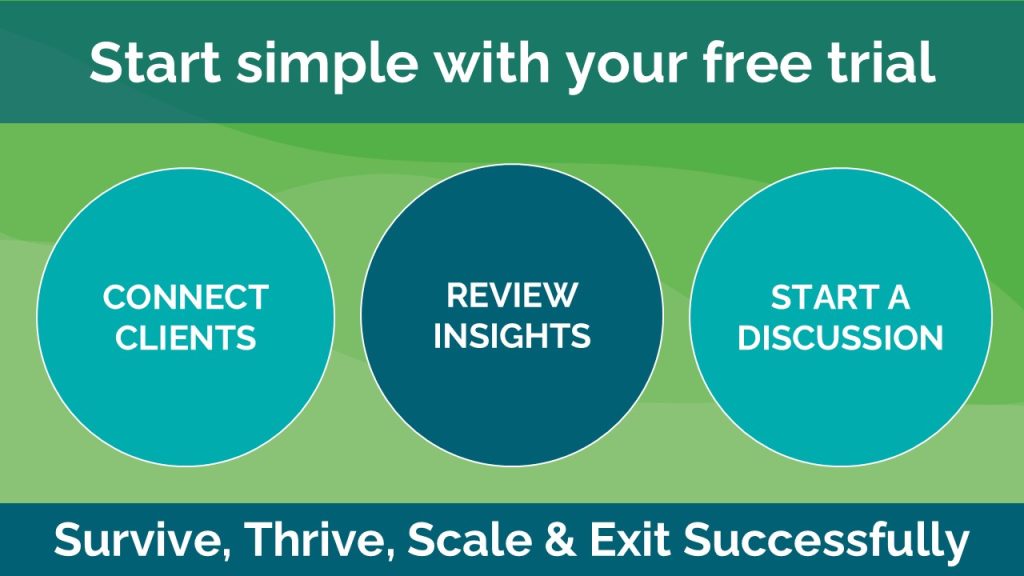
A practical starting point for your firm
You do not need to redesign the whole advisory service before beginning. Establish a usable first version and improve it as the team gains experience.
Client portfolio prioritisation questions
Does every financial change justify a client conversation?
No. A prioritisation process should distinguish ordinary movement from a change that is sufficiently material to affect performance, cash or an important business decision. The threshold may be different for each KPI.
Should every client be assessed using identical criteria?
Consistency is important, but it does not require irrelevant measures to be applied to every business. Use a small number of clearly defined configurations where different commercial models make particular KPIs more or less meaningful.
What if the priority list is larger than the team’s capacity?
Keep the underlying assessment intact and use filters to create a manageable working list. This may be based on the strength of the opportunity, a particular issue, service relevance or the review period.
Can portfolio prioritisation support compliance-led firms?
Yes. It can add a focused, forward-looking element to an annual or periodic client review. The firm does not need to launch a separate full advisory service before using the process.
Does a data-led process replace the accountant’s judgement?
No. It provides a consistent evidence base and helps direct attention. The accountant or advisor still validates the findings, considers what is known about the client and decides how and when to begin the conversation.
See the complete process demonstrated
Watch the CORE Insights webinar to see how portfolio review, financial-impact analysis, meeting preparation and action tracking work together in practice.