




Beyond Compliance: How Better Financial Visibility Improves Funding Outcomes
See how clean, current financial information protects a business's funding choices, improves lender confidence and helps accountants move from retrospective compliance to commercially valuable advice.
Turn reliable financial information into better funding choices
The session explores what lenders need to see, why good businesses can still be rejected, and how earlier collaboration between the owner, accountant and responsible finance broker can replace urgent borrowing with properly planned funding.
How does financial visibility affect access to business funding?
Current, reconciled and explainable financial information gives lenders greater confidence in the business's ability to repay. It allows the funding requirement to be identified earlier, gives the broker time to approach more suitable lenders and helps the business demonstrate its trading performance, existing commitments, seasonality and cash generation. When information is late or unreliable, choices narrow and the price of capital can rise.
What you will learn
Build lender confidence
Understand why reconciled accounts, a balance sheet that ties and consistent monthly reporting are essential to a credible funding application.
Preserve funding choices
Spot cash, margin and working-capital pressure before the requirement becomes urgent and established lending options disappear.
Match the facility to the need
Separate a temporary timing gap from a structural problem and consider the repayment source, protection required and exit route.
Move beyond compliance
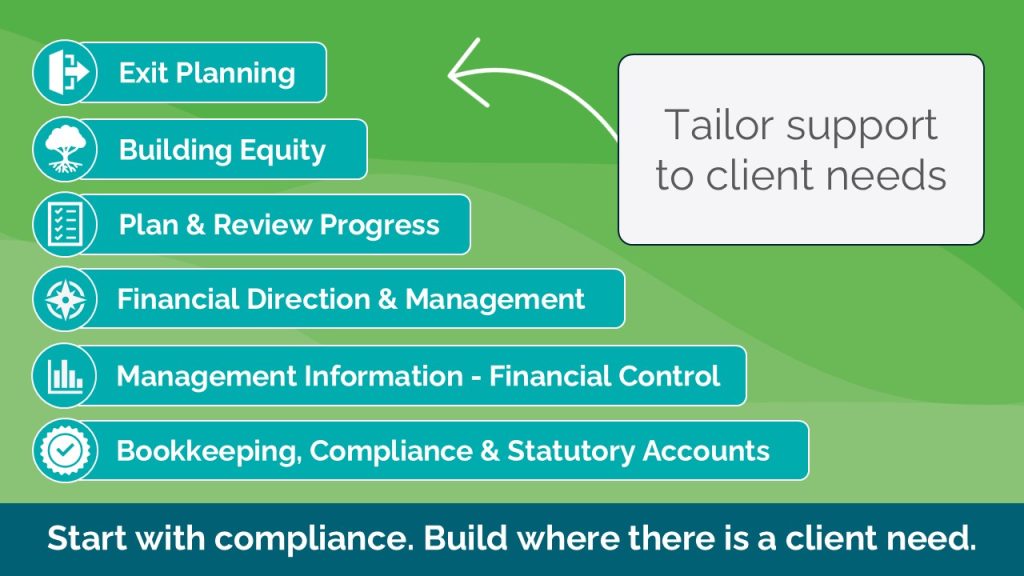
Use financial information to help clients prepare, understand their options and approach funding as part of a forward-looking plan.
Prepare before the funding requirement becomes urgent
Better funding outcomes are often secured before an application is submitted. This practical sequence helps turn financial records into reliable evidence and gives the business time to consider the right options.
Close the accounts consistently
Reconcile the bank, complete the month-end process and maintain a balance sheet, profit and loss account and debt position that can be explained.
Interpret the current position
Review margins, working capital, cash movement, owner drawings, dividends, debt commitments and seasonal patterns.
Identify the requirement early
Use forecasts and regular conversations to distinguish a temporary cash timing gap from an underlying profitability or structural issue.
Prepare the funding evidence
Bring together the current accounts, debt schedule, bank evidence, forecast and a clear explanation of how the facility will be repaid.
Compare suitable options
Consider price, term, security, flexibility, early repayment and the exit route—not simply how quickly the funds can be released.
The information behind a credible application
Established lenders are assessing repayment capacity, not demanding administration for its own sake. A clear, consistent pack reduces uncertainty and helps the lender understand the opportunity.
| Information | What it helps demonstrate | Common problem |
|---|---|---|
| Balance sheet | The assets, liabilities, reserves and overall financial position of the business. | Control accounts do not reconcile or balances cannot be explained. |
| Profit and loss account | Current trading performance, margins and the business's ability to generate profit. | Figures are annual, out of date or inconsistent with the business plan. |
| Monthly year-to-date results | Trends, seasonality and whether performance is strengthening or weakening during the year. | The business only has filed accounts and cannot provide a reliable monthly view. |
| Debt schedule | Existing facilities, repayments, interest, security and maturity dates. | Commitments are incomplete or the effect of additional borrowing has not been modelled. |
| Reconciled bank evidence | The real cash position and evidence that the underlying accounting records can be trusted. | The bank has not been reconciled or does not agree with the accounting system. |
| Cash-flow forecast | The timing of the requirement, repayment source and the effect of the proposed facility. | The request is based on an urgent figure without a clear explanation of what happens next. |
Find the section you need
Use these transcript-based timings to find each topic. Select a time to open that point in the recording on Vimeo.
Introduction and advisory opportunity
Why accurate, current information protects funding choices and supports more valuable client conversations.
Trust over transactions
How rising costs, cash extraction and unchecked growth can combine to create funding distress.
Why businesses arrive unprepared
The gap between what owners believe their accountant provides and the management information the business actually has.
Short-term lending and loan stacking
A client example showing how repeated urgent facilities can consume cash and remove future options.
What established lenders need to see
The balance sheet, profit and loss account, debt schedule, monthly results and bank evidence behind a sustainable facility.
Can the lender trust the numbers?
How reconciliations, cash conversion, seasonality and explainable risks affect lender confidence and pricing.
Why good businesses get rejected
A £500,000 stock-funding example showing how unreconciled accounts can block an otherwise viable application.
The compounding cost of a late month end
Why delayed information turns advice retrospective and makes the eventual funding request more urgent and expensive.
From firefighting to planned growth
How foresight creates time to approach banks, secure longer terms and consider whether finance is needed at all.
Refinancing case study
Replacing four high-cost facilities with a commercial mortgage and reducing monthly repayments by £19,278.
Four questions before arranging finance
Define the problem, repayment source, protections and exit route before choosing a facility.
Moving beyond compliance
How the owner, accountant and broker can work together to turn accounting records into funding power.
Questions and practical client examples
Discussion of the advisory opportunity, growth funding, agricultural property, NHS-linked contracts and suitable facilities.
Final lessons
Why solving today's problem can narrow tomorrow's choices, and how tax efficiency must be balanced with funding affordability.
Four questions to test the funding requirement
What problem is the capital solving?
Separate a temporary timing gap from an underlying cash-flow, pricing or margin problem.
What is the repayment source?
Identify the trading cash, seasonal income, asset sale or other event that will service or repay the facility.
What must remain protected?
Consider the cash buffer, security, operational capacity and other assets the business cannot afford to compromise.
What is the exit route?
Understand whether the facility will be repaid, renewed or refinanced and the risks attached to that route.
For professionals helping clients fund sustainable growth
The session is particularly relevant where clients are growing, experiencing cash pressure, considering capital expenditure or relying on annual accounts to understand performance.
- Accountants and practice owners looking to extend client conversations beyond year-end compliance.
- Business advisors helping owners understand cash, margin, debt and growth decisions.
- Fractional FDs and CFOs preparing businesses for borrowing, investment or refinancing.
- Client managers and bookkeepers responsible for reliable monthly closes and reconciliations.
- Owner-managed businesses wanting to understand what lenders need before finance becomes urgent.
Download the financial visibility and funding slides
Use the presentation alongside the recording to revisit the lender requirements, client examples, funding-readiness process and four questions to ask before arranging a facility.
Financial visibility and funding questions
Why do clean accounts affect access to business finance?
Lenders need to assess repayment capacity and understand the current position of the business. Reconciled, consistent and explainable accounts reduce uncertainty. If the figures do not agree or are out of date, a lender may decline the application, request more information or price the risk more defensively.
What financial information will an established lender normally require?
The precise request varies, but the webinar highlights full accounts, a current balance sheet and profit and loss account, monthly year-to-date results, a debt schedule, reconciled bank evidence and information showing how the proposed borrowing will be repaid.
Can a profitable business still be rejected for funding?
Yes. The business may be viable but unable to demonstrate its position with reliable current information. It may also have insufficient cash conversion, existing debt commitments or a funding request that is not clearly matched to a credible repayment source.
What is loan stacking?
Loan stacking occurs when several facilities are added in succession, often to cover recurring cash gaps or existing repayments. The combined servicing cost can consume cash and make refinancing increasingly difficult. Separate facilities can still be appropriate when each has a clear purpose and the total commitment is affordable.
Is borrowing always the right answer to a cash-flow gap?
No. The first step is to understand whether the gap is temporary or reflects a structural problem with pricing, margins, working capital or costs. Sometimes the appropriate outcome is to delay borrowing, change the plan or decide that finance would worsen the position.
What should a business consider before accepting a facility?
It should be clear about the problem being solved, the source of repayment, what cash or security must remain protected and how it will exit, renew or refinance the facility. Price, term, flexibility, fees and early-repayment conditions should all be understood.
How can accountants help clients achieve better funding outcomes?
Accountants can help clients maintain reliable monthly information, interpret margins and cash movements, forecast future requirements and begin the funding conversation earlier. This allows the broker to approach suitable lenders with a clearer case and gives the client more time to compare the options.
Turn compliance records into funding readiness
Select one client whose growth, working-capital pressure or investment plans may create a future funding requirement. Bring the records up to date, clarify the likely timing and purpose, and start the conversation while the business still has choices.